
The Definitive Guide to Cheap Airfare
Everything I’ve done to get from A to B for a fraction of the price.
Intro
For the longest time, I thought international travel was beyond my means. I grew up in the Midwest USA, far from any major airports. All we had were cows, corn, and a good attitude. You lived and died where you were born, where my family had lived since 1810.
The first time I went on an actual international tourism trip, I was FLOORED by the cost. As part of a college choir program, we toured Sweden, Estonia, and Latvia over the course of 10 days. Planned by a European travel agency, the entire trip cost US$4,500 in today’s money. That was an entire semester of my pitiful college wage. It set a standard for me that travel was supposed to be something rare, focused, and luxurious.
But just a few years into my professional life, I quit my job and traveled to 4 continents and 25 countries over 6 months, for a total airfare cost of $2,791.
Now, I’ve helped dozens, maybe hundreds, of people in my personal circles and on social media plan their routes and save money at rates they didn’t think were possible.
This is the complete guide to what I know: the toolbox, the mindset, and the techniques.
It’s not just a guide on “how to save money when flying.” I’ve found a new way of traveling, and I want to fundamentally change your perspective.
The Toolbox
I AM NOT AN AFFILIATE FOR ANY OF THESE PLATFORMS. I only recommend sites that I’ve personally used to some effect or heard good things about.
The Mindset
Extreme Flexibility
A lot of people lose out on the best deals because of time. Good things come to those who wait when it comes to airfare. If you can decide to plan your trip around airfare, instead of planning airfare around your trip, you will be home free.
The first trip I did was planned around one specific flight. I remember that, for the whole month, that flight was $800+ on that specific airline. Then one day, for some reason, it was $250. If you are flexible, you have all the power over airlines that will charge you as much as humanly possible if you have to be somewhere at a certain time.
High/Low Seasons: Most countries have “seasons,” or periods when there are more or fewer tourists. I have found low seasons to be much more enjoyable: lower accommodation costs, empty attractions, low traffic, and yes, lower airfare. This site has maps of high and low seasons.
Price Variability: Prices are constantly changing for the same route. You want to keep a careful eye on this.
One to three months tends to be the sweet spot, but I would search anywhere from now to nine months out. Past three months, you may actually be paying more. Past 11 months, you will start to run into inventory and search problems.
The general rule of thumb is that airlines will charge you more as flights get closer, but there are many exceptions to this rule. If a flight is soon and does not have enough capacity to be profitable, airlines get desperate and drop prices.
Price Alerts: Google Flights, Going, and Flyglitch are all sites that can notify you of the price drops mentioned above.
Time flexibility is important, but don’t underestimate location flexibility.
Let me ask you a question. Are you going somewhere? Or are you going somewhere? There’s a difference. If you’ve decided, “I’m good with going anytime,” you’re only one step away from, “I’m good with going anywhere.” In that case, you’ve now permanently solved the questions of where and when. Time and place now belong to you.
Define your real non-negotiables, become hyper-flexible for the rest, and you may have unexpected adventures of a lifetime.
Epic Journeys > Vacations
Longer trips are more bang for your buck. Imagine you want to visit Europe’s top five tourism cities: London, Paris, Amsterdam, Barcelona, and Rome. The problem is, you live on another continent.
Now you have a few choices. You can follow the vacation model, where you’re away for a week and come back, or you can try what I call epic journeys. If you go for a week, you are barely going to get through any one of these cities. You are going to be jet-lagged. The days you fly in and out are going to take a lot of time and energy.
Then there’s the airfare cost. If you take five round trips from the U.S., you could easily pay $6,000+ in airfare costs. Yes, taking a big journey is more expensive, but it’s way cheaper than taking a bunch of smaller journeys. Meanwhile, if you fly into Europe from the U.S., use European airlines to get around, and fly back, you can confidently get that to under $1,200, maybe even $1,000.
Amortization: This just means spreading a cost out over time. For example, you can buy cheap shoes that last three months, or highly durable ones that last a year. The durable ones cost 2x what the cheap ones cost. We now have a very easy-to-calculate value proposition. The highly durable ones cost 2x as much, but last 4x as long, so buying them gives you 2x the value of the other shoes.
When you spread the flight costs out over the length of an epic journey, the numbers become far more favorable. Going back to my choir trip, about $2,500 of that was flight costs. For a 10-day trip, my per diem was $250/day for flights. However, on my epic journey, it was $2,800/180 days = $15/day. Big difference!
This is another dimension in which flexibility is king. The more flexible you are, the more financially advantageous your trip becomes.
The Techniques
The following are all different techniques I’ve used to get lower prices. Sometimes I use many of them in the same route!
1. Intercontinental Priority
If you save 20% on a $100 flight, you just saved $20. If you save 20% on a $1,000 flight, you just saved $200!
For this reason, I always prioritize the intercontinental flight. I say intercontinental instead of international because many international flights aren’t long at all. It doesn’t always work because airlines can punish you for booking all direct routes, but I like to build the route around a single low-cost, multicontinental flight, then build budget domestic routes around that.
The reason this works is because more options = lower cost. There are a lot more flights going in and out of Europe than there are going in and out of Germany. If you have an entire continent of options, you are going to find something good. Plus, you can rely on established low-cost routes, like JFK → FCO, as discussed earlier.
Use Kiwi, Google Flights, PanFlights, or Skyscanner and search by regions or continents.
2. Split Itinerary
Pretty straightforward, and best to do between two mid-sized airports. By splitting the itinerary into two legs, you are drastically increasing your options and lowering your prices.
A good example of this is a video I previously did on South Korea to Krasnoyark, Russia. This route is impossible without a split itinerary.
Start from your airport, Airport A, then use FlightConnections to find major hubs, Airport B, that connect with your airport.
Go to a flight aggregator site of your choice and search A → B and B → C separately. If you’re not happy, repeat with another hub airport.
WARNING: You are adding some risk by doing this. Airlines are not obligated to complete your route if there is a delay and you miss your second flight. You may get stranded. If you’re hyperflexible, this shouldn’t be too much of a problem. I’ve done this over 40 times and never missed a flight, but the risk is there.
3. Intermodal Substitution
Sometimes it makes sense to use other forms of transportation for distances that would normally be covered by flying, especially in areas with lower coverage.
When I was traveling in Georgia, rail was a no-brainer. They had a rail line that went from Batumi to Tbilisi, the largest airport, for under $10. I could have flown, but trying to fly out from Batumi, or flying to Tbilisi first, would have been about $200–300.
Most of Europe and Asia have robust passenger rail, but intercity rail can get quite pricey. Bus options are frequently cheaper.
I have found buses to be the best option in lower-income countries, especially in South America. Rideshare and taxis also tend to be affordable.
4. Brute Force
Brute force refers to searching across all flight aggregators with your specific cities. Sometimes you’ll find a glitch in the matrix!
I recently featured this on my channel when searching for Helsinki to Auckland flights:
Keep in mind this will normally be a split itinerary, and very, very poor quality.
5. Happy Layover
When I was planning a flight from Malaysia to the USA, I realized it would be much cheaper if I stayed four days in Taiwan along my route. Most people would never consider a layover like that, but I had never been to Taiwan, so it just became part of the adventure!
You can do this with any complex route. If you’re creating a split itinerary, consider searching second legs that are a day or two further out.
6. Points and Airline Loyalty Programs
Most of the techniques described above don’t work with points, but I would be silly not to mention this.
Loyalty: Even if you don’t have access to robust points networks, consider signing up for loyalty programs anyway! You might automatically get perks or discounts you didn’t expect.
Churning is the real deal! I churned 80,000 points with one card, thanks to a special offer, and that paid for a North America → South America flight, an Asia → North America flight, and I still have points left over!
If you spend money, you could be earning points, and points convert much better for travel than in any other category, especially business or first class.
There are a lot of travel channels out there that exclusively focus on this. There are also apps like point.me that can search across different airlines.
7. ADVANCED: 3-Dimensional (or 4-Dimensional) Comparison Charts
Rarely necessary, but if you want to take an extreme and effective approach to finding the absolute best prices, you can save all possible combinations of your route to a spreadsheet for the grittiest comparison possible.
For example, I was looking for an airline-specific flight, to use my points, from Kuala Lumpur (KUL) to Chicago Midway (MDW). Not actually. I’m editing the route for privacy. This flight is normally over $1,000. I got it for around $120 + 35k Delta points. I did that using comparison tables. This took at least a couple hours.
Step 1: Here are the “dimensions”:
Dimension 1: I found every airport in Asia that Delta flies out of using their 2026 widebody schedule: ICN, HND, PVG, TPE, HKG.
Dimension 2: I found every airport in the U.S. that Delta flies to from Asia: ATL, DTW, LAX, MSP, SLC. I also added my local airport for comparison, MDW.
Dimension 3: I found all of the cheapest flights going from KUL → any of the Delta Asia airports.
Lastly, I added ORD, Chicago O’Hare, to have something to compare to. This was the result:
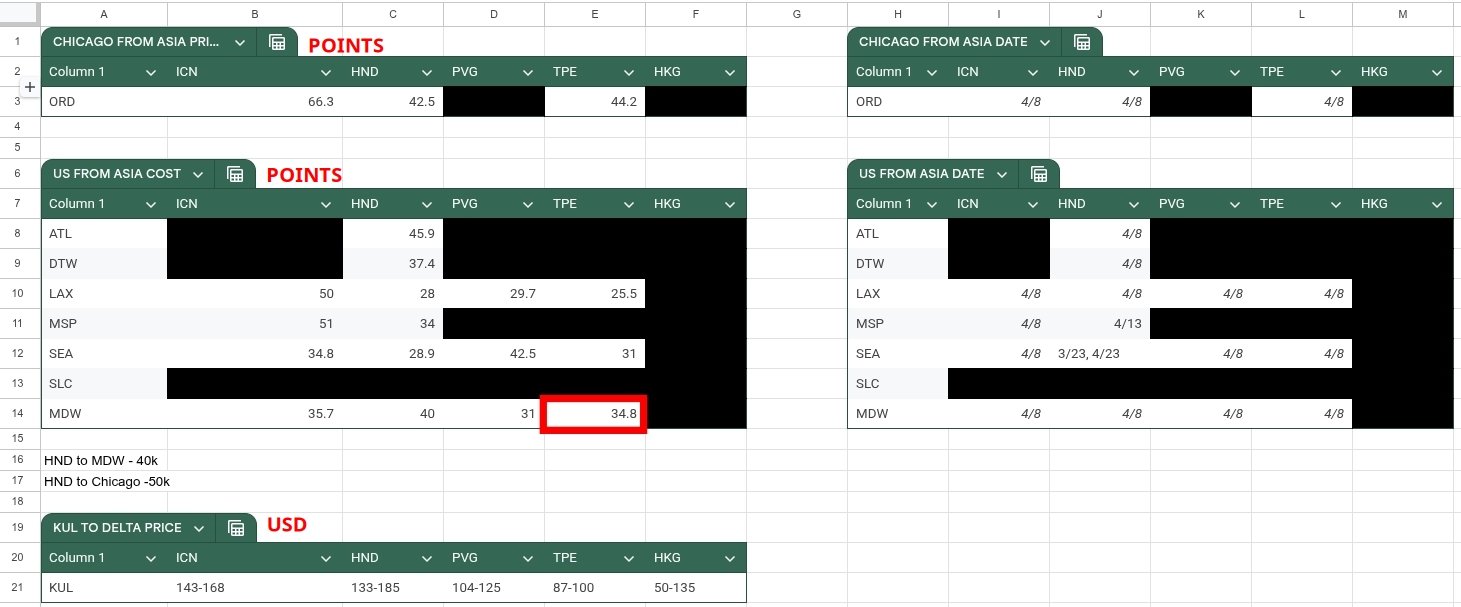
Step 2: Once I had all the data in one place, with unavailable flights blacked out, I compared the following booking options:
KUL → any Delta Asia hub → any U.S. Delta hub → MDW
Middle-left table + bottom-left table + costs for U.S. → MDW, not shown
KUL → any Delta Asia hub → ORD
Top-left table
KUL → any Delta Asia hub → MDW
Middle-left table
The tables on the right kept track of dates so I didn’t schedule flights in the wrong order.
Step 3: Compare the lowest values from the tables for each option:
KUL → TPE → LAX → MDW = 25.5k + $87 + $200 = $287 + 25.5k points
KUL → TPE → ORD = 25.5k + $87 + $150 = $237 + 25.5k points
KUL → TPE → MDW = 34.8k + $87 = $87 + 34.8k points
Option 3 ended up being the cheapest option, and saved me a trip from ORD → MDW.
Conclusion
Essentially, the goal is to beat the algorithm, and there’s no tool out there that can fully do this because, well, algorithms are the tools.
If you’re interested in flight planning services, I created Frugal Flyerz as a tailored, ready-to-book itinerary service. We currently guarantee $200 in savings on eligible single-route plans. We’re not just a budget planner either, so check us out!
That said, I believe in freely distributing what I know. Anyone can learn how to do this, and there are no secrets. That’s the point of this guide.
But if you want solutions now and don’t want to question your sanity, please reach out!
